Couch Potato Cafe | Everyday Tech
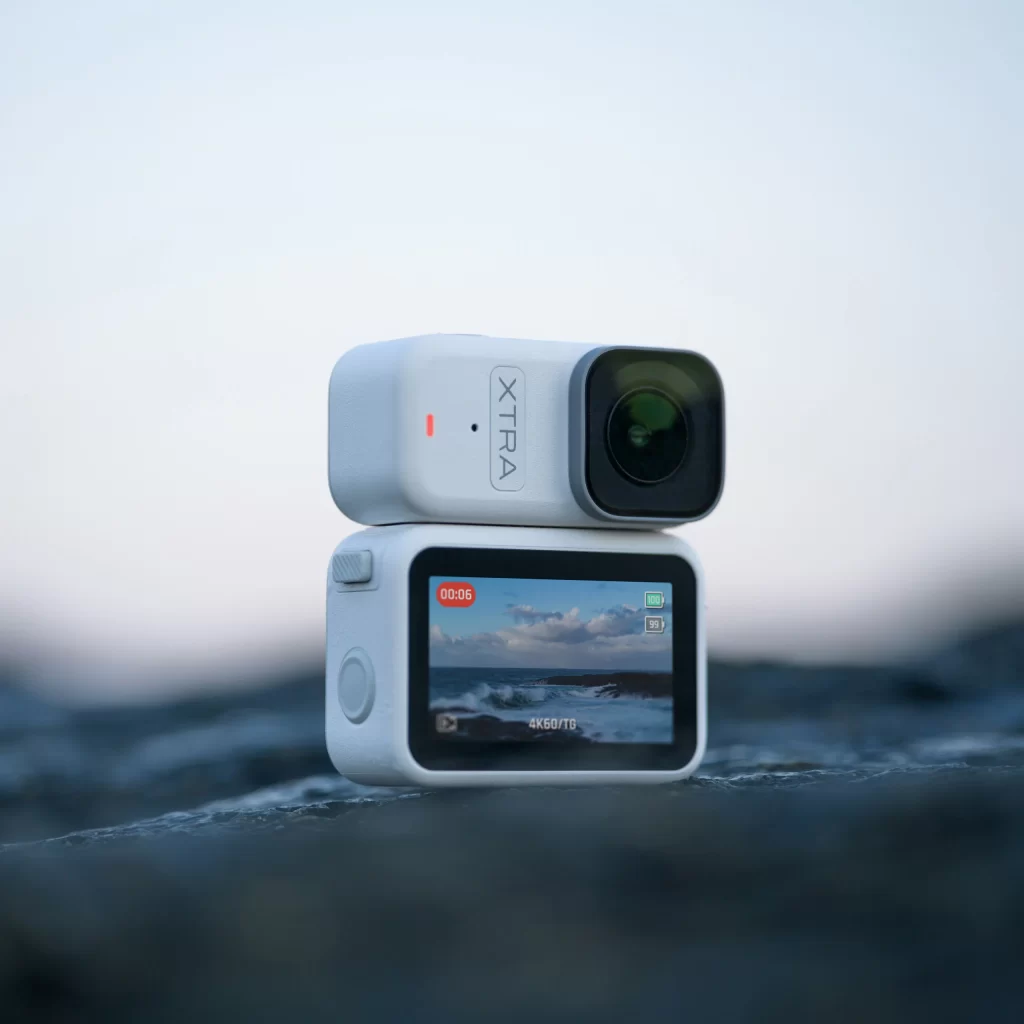
Holding your phone while filming a cooking tutorial, mounting a bulky action camera for a bike ride, or trying to capture genuine moments while actually living them—these scenarios share a common frustration. Sometimes the best shot is the one where you’re not thinking about holding a camera at all.
Enter the world of wearable cameras designed specifically for that use case. These aren’t meant to replace your DSLR or even your smartphone for every situation. Instead, they excel when recording needs to happen in the background while you’re focused on the actual experience—whether that’s hiking a trail, fixing something in your garage, or documenting a city walk without looking like a tourist holding up an iPhone.
The Xtra Atto enters this space with a specific promise: genuine hands-free 4K capture in a package small enough to forget you’re wearing it. Developed by Xtra, a U.S.-based startup that’s already built a reputation with products like the Xtra Muse, Edge, Edge Pro, and Sphra360, this camera takes a modular approach. The tiny recorder pairs with what they call the Multifunctional Vision Dock—essentially turning storage expansion, extended runtime, and remote control into optional add-ons rather than built-in bulk. For content creators chasing authentic POV moments where setup time kills spontaneity, this design philosophy could solve some genuine workflow headaches.
The Xtra Atto Connection to DJI Osmo Nano: What You Need to Know
They’re Essentially the Same Camera
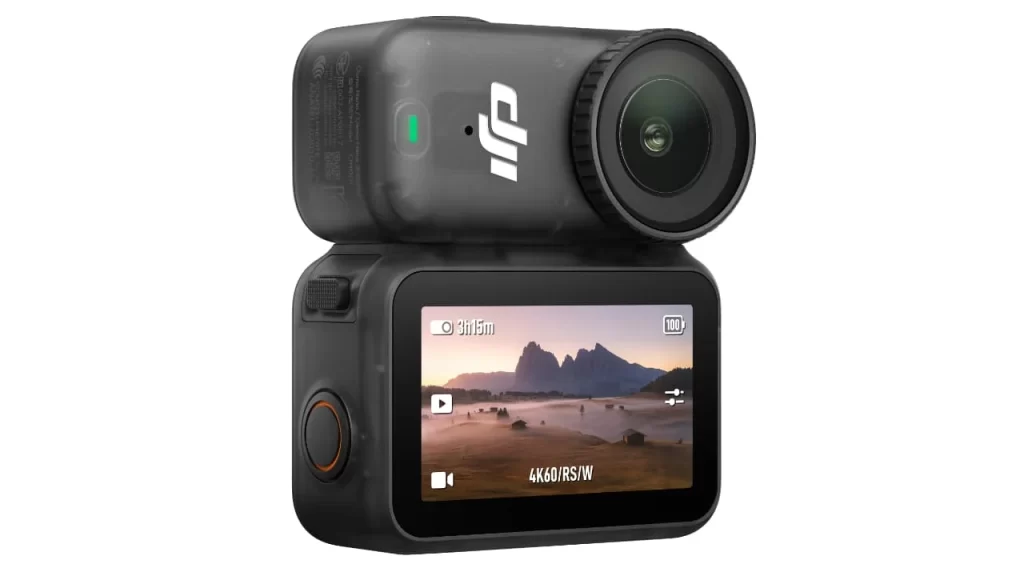
The Xtra Atto appears to be a rebranded version of the DJI Osmo Nano, specifically tailored for the US market as DJI faces increasing tariffs and import challenges.
Why This Matters: The Trade/Tariff Workaround
Xtra Technology appears to be selling exact hardware copies of DJI products, with the same components inside, the same boards, and the same chips as DJI, according to FCC teardowns3. This allows DJI technology to enter the US market while avoiding tariffs that have significantly increased prices on DJI-branded products.
Nearly Identical Hardware & Features
The cameras share virtually identical specifications, The same DJI Nano is $30 more than the ATTO
Big Sensor, Tiny Package: The Core Hardware Story
Quick Specs Snapshot:
- Brand: Xtra
- Max Resolution: 4K at 60fps
- Sensor: 1/1.3-inch CMOS
- Weight: 54 grams (1.9 oz)
- Field of View: 143 degrees
- Connectivity: USB 3.1, Wi-Fi 6, Bluetooth
- Water Resistance: 10m (camera only not the Vision Dock)
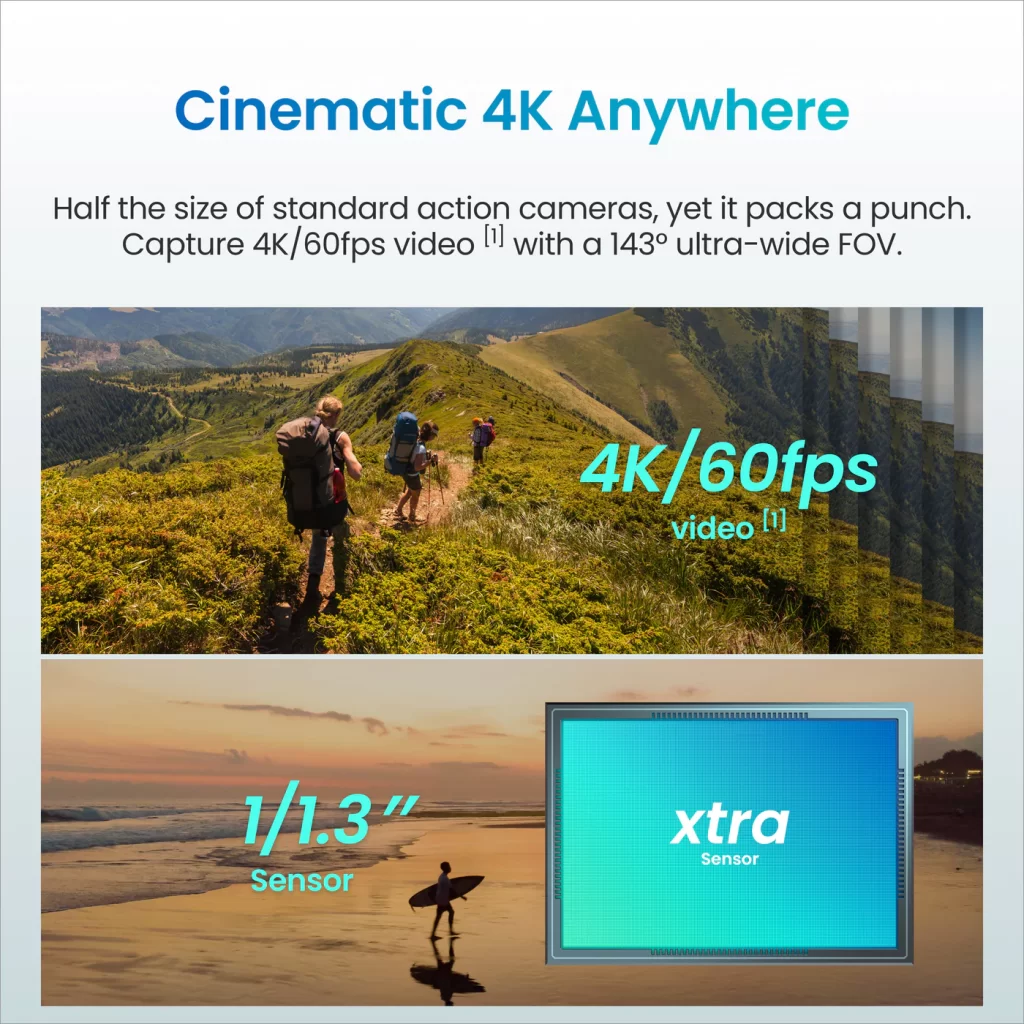
What makes the Atto interesting from a hardware perspective isn’t just its size—it’s what Xtra managed to fit inside that size. The 1/1.3-inch CMOS sensor sits at the heart of this camera, and that sensor size matters more than most spec sheets let on.
Here’s why: many ultra-compact wearables compromise on sensor size to save space and battery. Smaller sensors mean less light-gathering capability, which translates to noisier low-light footage and less dynamic range overall. A 1/1.3-inch sensor puts the Atto in the same league as premium action cameras that typically cost significantly more and weigh considerably more.
Paired with that sensor is 4K recording at 60 frames per second. That frame rate gives you smooth motion capture—critical when you’re filming activities involving movement. Compare this to budget mini-cams that cap out at 4K/30fps, and you’ll notice the difference immediately when panning, walking, or capturing anything with motion. The higher frame rate also provides flexibility in post-production: you can slow footage down to 50% or 40% speed and still maintain smooth playback, which is gold for short-form content on platforms like Instagram Reels or TikTok.
The camera sports a 143-degree wide field of view, which essentially means “what you see is what you get.” This ultra-wide perspective minimizes the need for constant reframing and helps maintain immersion in POV-style content. For everyday creators filming walkthroughs, travel diaries, or process videos, that width captures context without requiring you to think like a cinematographer.
One detail worth noting: the camera uses an f/2.8 aperture. While not the widest available, it strikes a balance between light gathering and depth of field for this type of shooting scenario.
Mounting Freedom: Going Where Smartphones Can’t
At just 54 grams, the Xtra Atto weighs roughly the same as a standard AA battery. That almost absurd lightness unlocks mounting possibilities that simply don’t work with heavier gear.
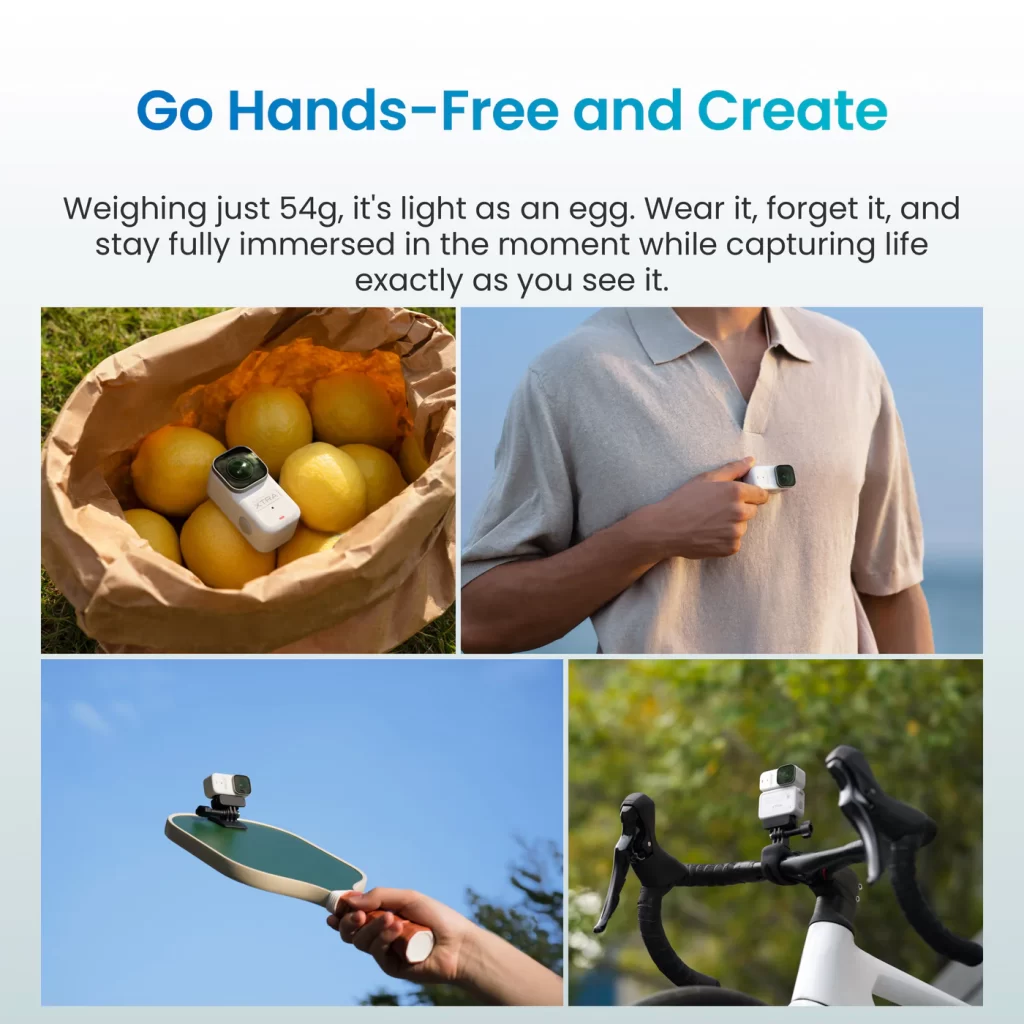
Think about it practically: clipping a 200-gram smartphone to a baseball cap brim throws off balance and creates neck strain. Chest-mounting a full-size action camera during a three-hour hike becomes uncomfortable. Attaching recording gear to a pet? Forget it with conventional cameras.
The Atto’s featherweight design makes all these scenarios actually feasible. Hat clips, chest harnesses, pet collar attachments, motorcycle helmet mounts, dashboard placements, even unusual tight-space positions for behind-the-scenes footage—these setups work specifically because the camera doesn’t fight against comfort or physics.
For creators experimenting with perspective, this opens creative doors. Low-angle shots from unconventional positions, extended wearable recording sessions that don’t fatigue, quick repositioning without elaborate rig adjustments—the small form factor actively encourages trying angles that would otherwise get skipped as “too complicated.”
Extended wear matters too. Recording a full day of travel content or documenting a multi-hour project becomes realistic when you genuinely forget the camera’s there. That’s where the weight advantage shows its real value.
Keeping Things Smooth: How MotionMaster and TiltGuard Work
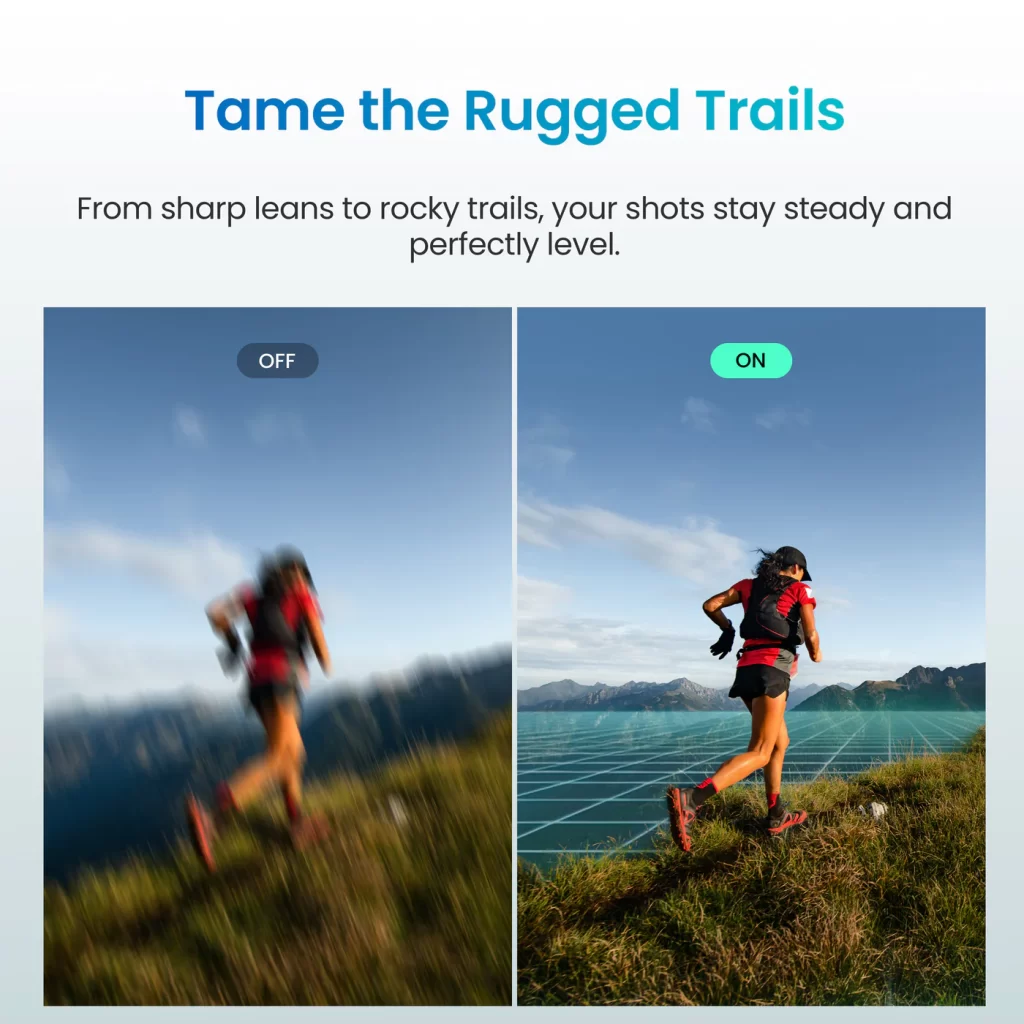
Handheld stabilization is hard. Hands-free stabilization is harder. When you’re walking, running, cycling, or just moving naturally, your body creates constant micro-movements that translate directly into shaky footage—unless the camera actively compensates.
The Atto includes two distinct stabilization systems designed for different problems:
MotionMaster tackles shake and vibration. This mode activates during active movement—think walking tours, running, cycling, skateboarding, or any scenario where your motion creates camera shake. The electronic stabilization analyzes movement patterns and applies corrective smoothing in real-time, reducing that jittery handheld look that screams “amateur footage.”
TiltGuard solves a different issue: horizon drift. Even when you’re moving smoothly, uneven terrain, head tilts, or asymmetric mounting can cause footage to gradually lean left or right. Rather than fixing this in editing (which crops the frame and takes time), TiltGuard actively maintains level horizons during recording. This feature works at 1080p and 4K resolution in 16:9 aspect ratio, keeping your footage straight without post-production intervention.
Important limitation to note: electronic stabilization disables during slow-motion recording and time-lapse modes. This is standard across most cameras in this category, as the computational overhead conflicts with those specialized recording modes.
What separates in-camera stabilization from post-production fixes? Time and image quality. Correcting shaky footage afterward requires cropping into the frame and applying computational stabilization that can introduce artifacts. Capturing stable footage from the start preserves full resolution and simplifies editing workflows—especially important for creators working on tight turnaround schedules.
The Vision Dock: More Than Just a Charging Base
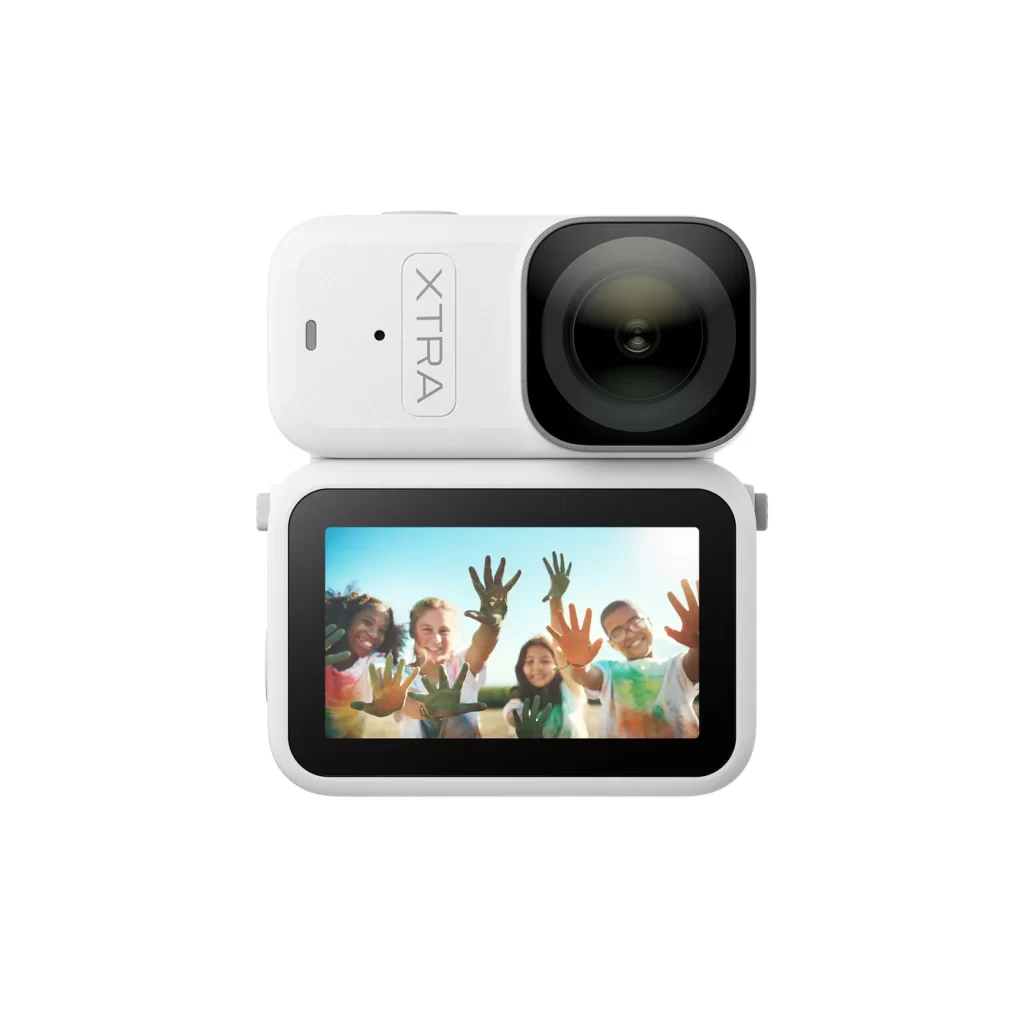
Here’s where Xtra’s modular design philosophy shows its thinking. Rather than building everything into the camera body (adding size, weight, and bulk you don’t always need), key features live in the Multifunctional Vision Dock.
This dock serves three specific functions:
1. Charging Station — The dock powers up both itself and the camera simultaneously, serving as a dedicated charging hub for the system.
2. Remote Controller — When magnetically connected, the dock provides physical control over recording without touching the camera itself. Useful when the camera’s mounted somewhere you can’t easily reach.
3. Storage Expansion Hub — The camera includes 128GB internal storage (with 107.6GB usable). The dock accepts microSD cards up to 1TB, dramatically extending recording capacity for long sessions or multi-day trips without offloading.
The magnetic attachment system allows the camera to mount in either direction. This means quick switching between POV perspective (filming what you see) and selfie mode (filming yourself) without changing mounts or fiddling with settings. For creators who mix talking-head segments with POV clips, this speeds up workflow considerably.
Regarding water resistance: the camera alone achieves waterproof rating to 10 meters depth, handling rain, splashes, pool use, and shallow water activities without protective housing. When connected to the Vision Dock, the combined system drops to IPX4 water resistance—still protected against splashing water from any direction, but not submersion. The dock isn’t designed for underwater use or high-pressure water exposure like jet skis or waterfall spray.
Power Management: Short Sessions and All-Day Recording
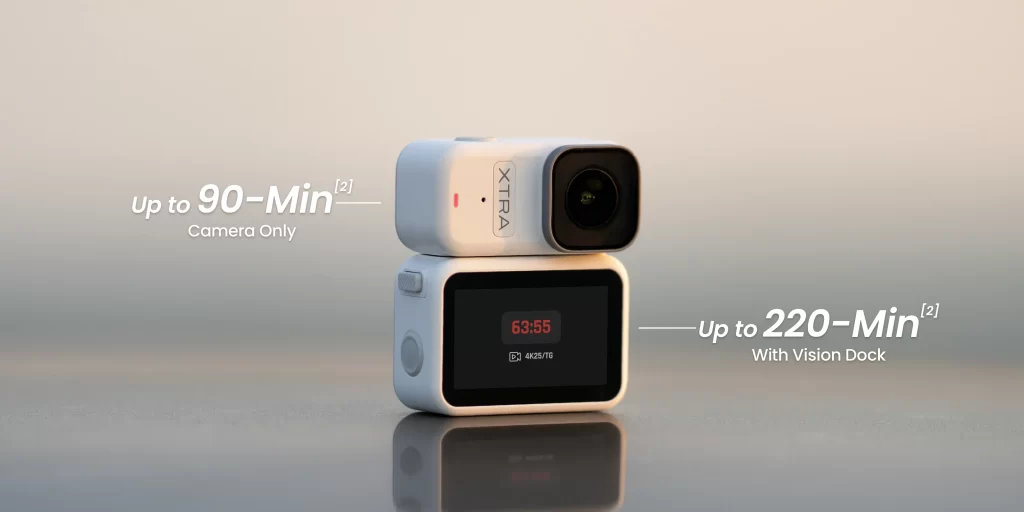
Battery strategy follows the modular theme. The camera contains a 530mAh battery providing up to 90 minutes of continuous recording. For short filming sessions—morning routines, quick tutorials, brief POV clips—that’s sufficient without adding extras.
When longer runtime matters, connecting the Vision Dock adds a 1,300mAh battery, extending total operating time to 220 minutes (roughly 3.5 hours). That makes all-day travel filming, extended events, or long outdoor activities practical without constant recharging anxiety.
Charging speed stays reasonable: the camera reaches full charge in approximately 40 minutes via the dock. Charging the complete system (camera plus dock together) takes around 50 minutes when connected to appropriate USB-C power delivery.
For context, 90 minutes of standalone battery puts the Atto in line with compact action cameras in similar size classes. The dock extension to 220 minutes is where it pulls ahead, offering near-action-camera endurance without the bulk of those larger devices.
Fast File Transfers for Modern Editing Workflows
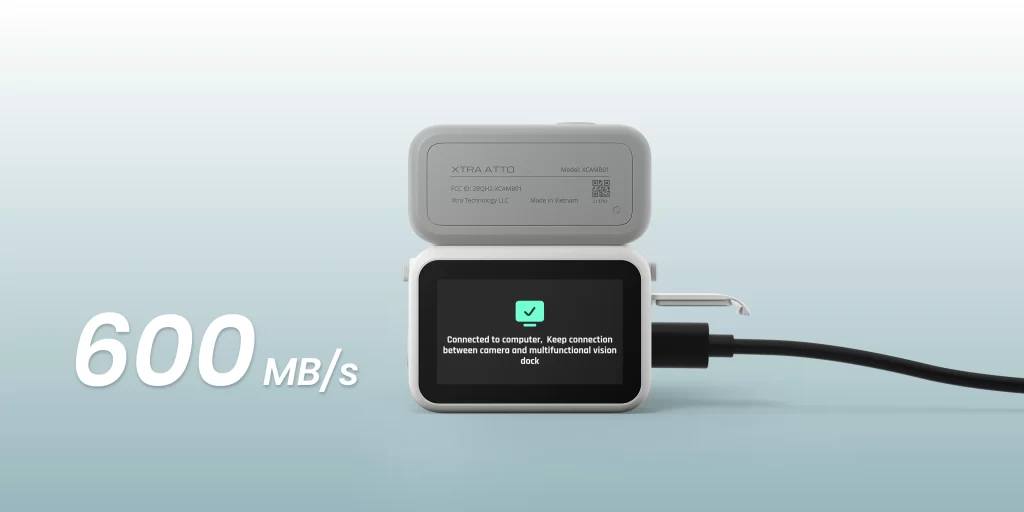
Capturing 4K footage means dealing with large file sizes. A few minutes of 4K/60fps recording can easily create multi-gigabyte files. Getting those files off the camera and into editing software quickly becomes the workflow bottleneck—unless transfer speeds keep pace.
The Xtra Atto supports USB 3.1 data transfer at speeds up to 600MB per second. In practical terms, that means offloading an hour of 4K footage could take just a few minutes rather than the frustrating 30+ minute waits associated with older USB 2.0 connections or slow wireless transfers.
For creators who work primarily mobile-first, the camera includes Wi-Fi 6 connectivity supporting wireless transfer speeds up to 80MB per second from internal storage to smartphones or tablets. This enables quick clip transfers for social media posting, mobile editing in apps like CapCut or InShot, or cloud backup without needing cables.
Why does this matter for everyday creators? Fast transfers mean less downtime between shooting and publishing. When you’re creating daily content or need to post quickly while moments are still relevant, cutting transfer time from 30 minutes to 5 minutes directly impacts how fast you can go from idea to published video.
The camera also supports Bluetooth connectivity (BLE 5.1 on camera, BLE 5.4 on dock) for app pairing and remote control functions.
Detailed Technical Specifications
Physical Dimensions:
- Camera body: 54.25 × 29.18 × 27.25 mm
- Vision Dock: 60.45 × 42.16 × 22.18 mm
- Camera weight: 54g (1.9 oz)
- Dock weight: 73g (2.6 oz)
Imaging Hardware:
- Sensor: 1/1.3-inch CMOS
- Lens: 143° field of view, f/2.8 aperture
- Focus range: 0.35m to infinity
- Maximum photo resolution: 6880 × 5160 pixels (~35MP)
Video Capabilities:
- 4K (3840×2160) at 24/25/30/48/50/60fps in 16:9
- 4K (4096×3072) at 24/25/30/48/50fps in 4:3
- 2.7K at multiple aspect ratios and frame rates
- 1080p at up to 60fps standard, 240fps slow motion
- Slow motion: 4K/2.7K at 120fps, 1080p at 240fps
- Maximum bitrate: 120 Mbps
- Video codec: HEVC (H.265) in MP4 container
Photo Features:
- Formats: JPEG and RAW
- Single shot at approximately 35MP
- Burst mode: up to 30 images in 3 seconds
- Pre-record buffers: 5/10/15/30 seconds, 1/2/5 minutes
Audio:
- Dual microphones
- 48kHz 16-bit AAC audio recording
Storage:
- Internal: 128GB total (107.6GB available)
- Expandable via Vision Dock: microSD up to 1TB
Connectivity:
- Wi-Fi 6 (802.11 a/b/g/n/ac/ax)
- Bluetooth: BLE 5.1 (camera), BLE 5.4 (dock)
- USB 3.1 Gen 2 (up to 600MB/s transfer)
Power:
- Camera battery: 530mAh (2.041Wh)
- Dock battery: 1,300mAh (5.031Wh)
- Recording time: 90 min (camera), 220 min (with dock)
- Charging time: ~40 min (camera via dock), ~50 min (full system)
Durability:
- Camera alone: Waterproof to 10m
- Camera + Dock: IPX4 splash resistance
Included Accessories:
- Xtra Atto camera (128GB)
- Multifunctional Vision Dock
- Magnetic hat clip
- Magnetic lanyard
- Protective carrying case
- USB-C to USB-C cable (USB 3.1)
- Dual-direction magnetic ball-joint adapter mount
Pros & Cons: The Couch Potato Cafe Verdict
What Works Really Well ✅
Exceptional portability — At 54 grams, this genuinely disappears when worn. No neck strain, no balance issues, no “I need to take this off now” moments during extended recording.
Serious sensor for the size — The 1/1.3-inch CMOS sensor punches above its weight class, delivering image quality comparable to much larger action cameras.
4K/60fps without compromise — Smooth motion capture at high resolution opens creative options for slow-motion effects and detailed footage that holds up during editing.
Modular battery strategy — 90 minutes standalone for quick sessions, 220 minutes with dock for all-day use. Choose your setup based on actual needs rather than carrying unnecessary bulk.
Fast transfer speeds — USB 3.1 at 600MB/s and Wi-Fi 6 at 80MB/s means less waiting, more creating. Critical for daily content workflows.
Dual stabilization modes — MotionMaster for shake reduction and TiltGuard for horizon leveling handle different stabilization needs without post-production intervention.
Reversible dock mounting — Magnetic attachment in either direction makes switching between POV and selfie perspectives effortless.
Genuine waterproofing — 10-meter depth rating on the camera body handles real-world water exposure without fussy cases.
What to Consider Before Buying ⚠️
Stabilization limitations — Electronic stabilization disables in slow-motion and time-lapse modes, which is typical but worth knowing if those are primary use cases.
Dock reduces water resistance — While the camera alone handles submersion to 10m, attaching the Vision Dock drops protection to IPX4 (splash-resistant only). Plan accordingly for water activities.
Transfer speeds are “up to” claims — Real-world USB speeds vary by computer, operating system, and cable quality. Windows systems in particular often see lower speeds than maximum specifications.
Battery life depends on settings — The 90-minute and 220-minute figures come from controlled lab testing. Heavy use of 4K/60fps, frequent Wi-Fi transfers, or extreme temperatures will reduce actual runtime.
Limited third-party ecosystem — As a newer product from a smaller company, accessory options and mounting systems may be less extensive than established action camera brands.
No mention of low-light performance — While the sensor size suggests decent capability, the article doesn’t address how the camera performs in challenging lighting conditions.
Who Should Actually Buy This Camera?
The Xtra Atto makes the most sense for specific creator profiles rather than serving as a universal camera solution.
Daily vloggers and lifestyle creators who prioritize authentic POV content over cinematic production will appreciate the hands-free freedom and quick workflow. The ability to capture genuine moments without holding a camera fits content styles focused on real experience over staged shots.
Travel content creators working primarily mobile-first get dual benefits: minimal packing space and fast wireless transfers directly to phones for quick social posting. The extended battery option supports full-day exploration without recharging stops.
Activity and adventure creators filming cycling, hiking, skateboarding, climbing, or similar movement-focused content benefit from the lightweight design that doesn’t interfere with the activity itself. The stabilization keeps footage watchable without gimbal rigs.
Tutorial and process creators documenting cooking, crafts, repairs, building projects, or other hands-busy activities can mount the camera to capture overhead or POV angles while both hands stay free to actually work.
Behind-the-scenes documentarians looking for unobtrusive B-roll cameras that fit in tight spaces or unusual mounting positions will find the 54-gram weight enables setups impossible with larger gear.
Pet content creators can safely mount the lightweight camera to harnesses or collars for genuine animal-perspective footage without the weight concerns of heavier action cameras.
This camera likely doesn’t make sense for:
- Creators prioritizing absolute image quality over convenience (dedicated cameras or high-end smartphones still lead here)
- Those needing extensive lens options or interchangeable accessories
- Professional productions requiring advanced color profiles and extensive manual controls
- Creators who primarily shoot controlled, stationary content where hands-free capability offers no advantage
The Bottom Line: A Purpose-Built Tool for Modern Creators
The Xtra Atto doesn’t try to be everything to everyone. It targets a specific pain point—genuine hands-free POV capture that maintains quality without sacrificing convenience—and executes that vision with focused engineering choices.
The modular approach separates “always needed” features (sensor, stabilization, core recording) from “sometimes needed” capabilities (extended battery, storage expansion, remote control). This keeps the camera impossibly light while retaining the option to expand functionality when situations demand it.
For creators building content around lived experiences rather than staged productions, where setup time kills spontaneity and holding a camera changes the moment, the Atto offers a practical solution. The combination of 4K/60fps capture, dual stabilization modes, fast file transfers, and all-day battery potential creates a workflow designed around creating quickly and publishing faster.
At its current pricing on Amazon, the Xtra Atto positions itself in the premium compact wearable category—more expensive than toy-grade clip cameras, less costly than flagship action cameras. Whether that pricing makes sense depends entirely on how much value hands-free convenience adds to your specific content creation workflow.
For the Couch Potato Cafe audience creating everyday tech content focused on real-world usability over spec-sheet bragging rights, the Xtra Atto represents an interesting new option in the wearable camera space—particularly for creators who’ve been looking for exactly this type of hands-free solution.